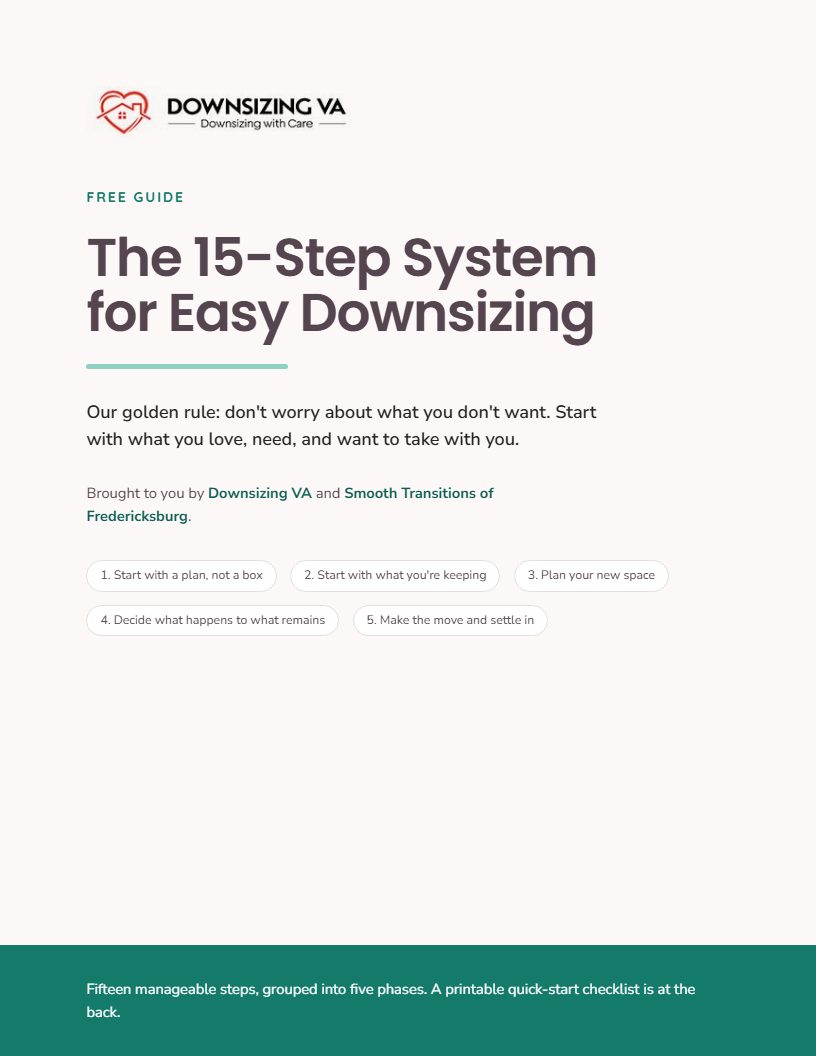
Downsizing feels huge until you break it into steps. That is the whole idea behind our free 5-Step System: a calm, doable order of operations that takes what looks like a mountain and turns it into a series of small, manageable moves. Most people who feel overwhelmed by downsizing are not lacking effort. They are lacking a sequence. When you know what to do first, second, and third, the whole project stops feeling like an avalanche and starts feeling like a plan.
Here is the system in full, with a little detail on how each step works and how they fit together. You can follow it yourself, or lean on a team for the heavy parts. Either way, the order is the same, and the order is what does the heavy lifting.
Step 1: Start with a plan and a move window
Before you touch a single box, decide two things: where you are going, and roughly when you want to be there. It sounds obvious, but skipping this step is why so many downsizing projects stall. Without a destination, every decision becomes harder, because you have no way to answer the only question that matters: will this fit the life I am moving toward?
Your destination does not need to be final. Even a rough idea gives the whole process a shape. Are you moving to a smaller home, a 55+ community, or closer to family? What is your target month? Write it down. A clear destination and a move window turn every later choice from an abstract “should I keep this?” into a concrete “does this belong in the next chapter?” The move window matters just as much as the destination, because a date, even a soft one, is what keeps the project moving instead of drifting. If you are selling the current home too, this is also the moment to loop in a real estate specialist, so the sale and the move are planned on one timeline from the very start rather than bolted together at the end.
Step 2: Sort by decision, not by room
The most common mistake is trying to finish one whole room before moving on. It is exhausting, because every room is full of hard choices, and progress feels invisible. Instead, sort by decision. Give every item one of four homes: keep it, gift it to someone who will treasure it, sell it, or let it go.
Start with the easy spaces, like a linen closet or the garage, to build momentum before you reach the tender things. And give yourself an important permission: you can keep the memory without keeping every object. A photograph of a beloved chair carries the story just as well as the chair itself, and it fits in an album. For the pieces that hold real meaning, ask whether a child or grandchild would love to carry them forward. Passing something on is not losing it. It is giving it a second life.
It helps to work in short sessions rather than marathon days. An hour or two at a time keeps the decisions clear and keeps the sorting from turning into an emotional flood. When you hit a category that is genuinely hard, the good jewelry, the photographs, the letters, set it aside in a clearly marked box and come back to it once the easier ninety percent is done. Momentum makes the hard choices easier when you finally reach them.
Step 3: Turn the rest into value
The things you are not keeping can be worth more than you expect. A lifetime of furniture, tools, china, and collectibles has value, and there is no reason to leave it on the table. A professionally managed estate sale or auction can turn those belongings into real money toward your move, priced by people who know what things are worth and handled so your family does not have to run it.
What does not sell can be donated, so nothing useful goes to waste and the house keeps emptying. This is one of the biggest reasons families bring in a team at this stage. Sorting is one job; appraising, staging, pricing, and running a sale is another job entirely, and doing it well is the difference between clutter and cash. A good team also knows the local buyers and consignment channels, so the right piece reaches the right person instead of being marked down and forgotten.
Step 4: Right-size to your new space
Before the move, measure your new rooms and your larger furniture, then sketch a simple layout so you know exactly what fits. This one step prevents the most common move-day heartbreak: arriving with a sofa or a dresser that will not fit through the door or up the stairs, and having to make a rushed decision in the driveway.
Planning the new space in advance also makes the keep-or-let-go decisions from Step 2 far clearer, because now you can see precisely how much room you have. When you know your new living room holds one sofa and two chairs, choosing which pieces come with you stops being emotional guesswork and becomes a simple matter of fit. Bring the pieces you love and use every day, the ones that make a place feel like home, and let the layout make the rest of the decisions for you.
Step 5: The move and the final clear-out
Moving day is the part most people dread, and it is exactly the part a good team can carry for you. Packing, the movers, the setup in your new home, and the final clean-out of the old house can all be coordinated by one team, so you are not juggling vendors and phone calls during an already emotional time.
The goal we aim for is simple, and it is the whole reason this step matters: you walk into your new home to find the beds made and the pictures hung, so the space feels like yours from the very first night. Meanwhile, the old house is left clean, cleared, and ready to hand over to its next family. No lingering trips back for forgotten boxes, no dumpster to arrange on your own.
How long does downsizing usually take?
Families often ask us how far ahead they should start, and the honest answer is that more runway is almost always better. When there is no deadline forcing the pace, a comfortable timeline for a full home is a few months, with the sorting spread out enough that no single week feels crushing. When a move needs to happen quickly, it can be done in a matter of weeks with a team carrying the load, though the calmer the timeline, the calmer the whole experience.
The point of the system is not speed for its own sake. It is to make sure the pace is yours. Starting earlier simply gives you more room to make good decisions, to let family weigh in on the pieces they might want, and to sell rather than scramble. If you are even a year or two away from a move, there is no harm in beginning the easy sorting now.
A few questions we hear a lot
Do I have to be there for all of it? No. The decisions about what to keep are yours, and only yours. But the labor around them, the packing, hauling, staging, and cleanout, is exactly what a team is for. Many families make the keep-or-let-go calls and hand the rest off entirely.
What if I cannot decide on something? Then do not, yet. Give yourself a “not sure” box for the genuinely hard pieces and keep moving. Most of those decisions get easier once the rest of the house is sorted and you can see clearly how much room the new space really holds.
Can you help with just one part? Yes. Some families want the whole move carried start to finish. Others just need help with the estate sale, or the final cleanout, or the real estate side. The system works either way, and we are glad to step in wherever the load is heaviest for you.
Get the free printable guide
This is the short version of the system. Our free guide walks you through each step in more detail, with a printable checklist to keep you on track from the first plan all the way to settling in. It is genuinely free, and it is a calm place to begin, whether you are moving soon or simply starting to think ahead.
Downsizing is never just about getting rid of things. It is about making room for what matters most in the next chapter. Get the free 5-Step guide, and when you want hands-on help, see how our team can carry the move from the first box to the last.